

close
Choose Your Site
Global
Social Media


Views: 0 Author: Site Editor Publish Time: 2025-10-29 Origin: Site


Transformers are essential components in modern electrical systems, enabling efficient voltage conversion and reliable power transmission. At the heart of every transformer lies its most critical element — the transformer core. Often described as the magnetic heart of the transformer, the core determines the efficiency, performance, and long-term stability of the entire device.
This article explores what forms the core of a transformer, the materials used, how it is designed and manufactured, and why it plays such an essential role in today’s evolving power infrastructure.
The transformer core serves as the essential conduit for magnetic flux, linking the primary and secondary windings. Its main function is to guide the magnetic energy generated by the alternating current (AC) through the primary winding to the secondary winding, enabling voltage conversion. A well-engineered core allows this magnetic flux to flow efficiently while minimizing energy loss, which is crucial for transformer performance.
Without an optimized core, transformers would suffer from significant energy losses, resulting in excessive heat generation and a reduced operational lifespan. This heat buildup not only wastes energy but also compromises the transformer's overall efficiency, making proper core design a critical factor in ensuring reliable power delivery.
When alternating current flows through the primary coil, it creates a fluctuating magnetic field around the winding. The transformer core channels this magnetic field, guiding the magnetic flux through the core and inducing a voltage in the secondary coil. For this process to occur efficiently, the core must possess high magnetic permeability — allowing magnetic flux to pass through with minimal resistance — and low hysteresis loss, which reduces the energy lost to heat. These properties enable the transformer to transfer energy with maximum efficiency and minimal operational loss.
A transformer core is not a solid block of metal but a precisely engineered assembly composed of laminated magnetic sheets, insulating materials, and mechanical support structures.
Component | Description | Function |
Usually silicon steel, amorphous alloy, or ferrite. | Guides magnetic flux with minimal losses. | |
Laminations | Thin insulated sheets stacked together. | Reduces eddy current losses. |
Insulation Coating | Oxide or varnish layer between laminations. | Prevents short circuits between layers. |
Clamping Structure | Steel frame or C-clamp assembly. | Provides mechanical strength and stability. |
Core Frame & Fasteners | Bolts, plates, and supports. | Keeps core aligned during operation. |
Together, these components form a magnetically optimized and mechanically stable structure that can withstand both thermal and electrical stresses.
The selection of core material is one of the most critical factors influencing transformer performance. The magnetic characteristics, conductivity, and manufacturing cost all impact the final outcome.
This is the most common material used in power transformers. GO steel features grains aligned in one direction, which allows magnetic flux to pass through with minimal resistance.
Advantages: Low core loss, high magnetic permeability, and excellent performance in high-capacity transformers.
Applications: Distribution and transmission transformers.
NGO steel has randomly oriented grains, resulting in isotropic magnetic behavior.
Advantages: Greater flexibility in design and use in multiple orientations.
Applications: Small dry-type transformers, motors, and electronic transformers.
Composed of non-crystalline structures, amorphous alloys minimize eddy current losses.
Advantages: Up to 70% lower core loss than conventional silicon steel, lightweight, and environmentally friendly.
Applications: Energy-efficient and eco-friendly transformers.
Ferrite cores, made from iron oxide and ceramic compounds, are ideal for high-frequency operation.
Advantages: Excellent magnetic properties at high frequencies.
Applications: Switch-mode power supplies, inverters, and electronic transformers.
Nanocrystalline materials combine low losses with very high permeability and stability.
Advantages: Compact, low magnetostriction, and superior thermal stability.
Applications: Smart grids, renewable energy systems, and advanced electrical devices.
Material Type | Magnetic Permeability | Core Loss (W/kg) | Typical Use |
GO Silicon Steel | High | 0.9–1.5 | Power Transformers |
NGO Silicon Steel | Medium | 1.2–2.5 | Dry-Type Transformers |
Amorphous Alloy | Very High | 0.2–0.5 | Energy-Saving Transformers |
Ferrite | Moderate | 0.3–1.0 | High-Frequency Transformers |
Nanocrystalline | Extremely High | 0.2–0.6 | Advanced Applications |
Different transformers use distinct core geometries to optimize magnetic flux distribution and minimize energy loss.
Windings are wrapped around two limbs.
Ensures efficient magnetic flux flow through the central limbs.
Common in distribution transformers.
The core encloses the windings for better magnetic shielding.
Reduces leakage flux and improves stability.
Used in industrial and dry-type transformers.
A circular, donut-shaped core offering minimal magnetic leakage.
Compact and highly efficient, requiring less copper wire.
Popular in compact power and electronic transformers.
Simplified for easy manufacturing and maintenance.
Ideal for medium-voltage dry-type transformers.
Often produced by Foshan Huage Electric Power Equipment Co., Ltd., using automated cutting and clamping processes.
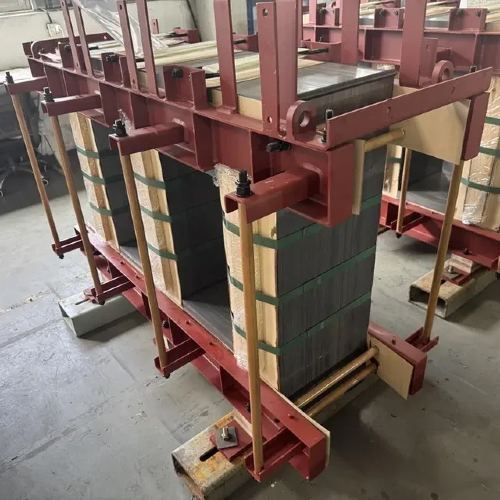
The precision of the manufacturing process directly affects a transformer core’s efficiency and reliability.
Premium silicon steel or amorphous alloys are chosen based on transformer type and operating conditions.
Factories such as Huage Electric Power Equipment Co., Ltd. use CNC laser cutting technology to achieve highly accurate dimensions, smooth edges, and minimal internal stress.
Sheets are layered with insulation coatings to prevent eddy current loss.
Heat treatment relieves mechanical stress and restores the material’s magnetic properties.
Cores are assembled using robust steel frames, clamps, and bolts for long-term mechanical integrity.
Final testing includes measuring core loss, magnetic flux density, and mechanical stability under international IEC/IEEE standards.
Manufacturing Step | Purpose | Key Outcome |
Cutting | Define geometry | High precision edges |
Stacking | Build magnetic path | Reduced eddy loss |
Annealing | Relieve stress | Improved permeability |
Clamping | Ensure strength | Reduced vibration |
Testing | Verify quality | Reliable performance |
To achieve high performance and consistency, multiple production parameters must be controlled:
Material Purity – Impurities reduce permeability and increase losses.
Lamination Thickness – Thin laminations (0.23mm–0.30mm) minimize eddy losses.
Insulation Coating – Proper insulation prevents interlayer short circuits.
Assembly Precision – Accurate stacking reduces vibration and noise.
Annealing Quality – Restores magnetic performance after cutting.
Quality Inspection – Ensures compliance with energy efficiency and mechanical standards.
Foshan Huage Electric Power Equipment Co., Ltd. is a specialized manufacturer of transformer cores, clamps, and silicon-steel components, known for its precision engineering and innovation.
Located in Foshan, China, Huage’s modern facility features advanced laser cutting systems, automated stacking lines, and annealing furnaces for high consistency and performance.
Dry-type transformer cores
Amorphous alloy cores
C-core and E-core assemblies
Customized silicon steel components
From OEM/ODM customization to technical consultation and after-sales support, Huage provides complete core manufacturing solutions for the global energy sector.
To guarantee efficiency, every transformer core undergoes standardized testing for:
Core Loss Measurement
Magnetic Induction Evaluation
Dimensional and Structural Accuracy
Thermal Stability and Stress Resistance
These procedures ensure reliable operation across various applications — from traditional power grids to emerging renewable energy systems.
As the global push for clean and sustainable energy accelerates, the demand for highly efficient transformers continues to rise. Transformers are expected not only to convert voltage reliably but also to minimize energy loss throughout their operation. At the heart of this efficiency lies the transformer core, which determines how effectively electrical energy is transmitted with minimal waste.
In modern renewable energy systems such as solar farms, wind power plants, and energy storage facilities, the performance of transformer cores is critical. Advanced materials, including amorphous and nanocrystalline alloys, have revolutionized transformer design by reducing energy losses by up to 70% compared to traditional silicon steel cores. These materials enhance magnetic efficiency, decrease heat generation, and ultimately extend the lifespan of transformers.
Furthermore, lightweight and compact core designs improve ease of installation, reduce transportation and handling costs, and simplify long-term maintenance. Manufacturers are also increasingly adopting environmentally responsible and recyclable materials, which align with global carbon reduction initiatives and sustainability goals.
By combining innovative materials, optimized design, and sustainable practices, transformer cores today ensure both high energy efficiency and reliable, long-term operation. This focus on core performance not only reduces operational costs but also supports the transition toward a cleaner and more sustainable energy future.
The transformer core is the magnetic backbone of every reliable and efficient power system. Its quality, material selection, and precision assembly define the overall energy efficiency and performance of transformers worldwide. Every stage — from raw material processing to final testing — contributes to achieving superior transmission capability and operational stability.
For organizations and engineers seeking advanced transformer core solutions, Foshan Huage Electric Power Equipment Co., Ltd. represents a trusted partner in innovation and reliability. With automated production, professional engineering support, and a commitment to excellence, Huage continues to empower the global power industry.
To explore more about their high-performance transformer cores or discuss potential collaboration, readers are encouraged to reach out to Foshan Huage Electric Power Equipment Co., Ltd. for professional consultation and customized solutions.